
Street Dog Guide
What Is a Street Dog?
Street dog: a dog that lives freely within human communities rather than belonging to a single household.
Before Guante came along I thought a street dog meant stray, like a dog that got lost or someone dumped on the side of the road. I learned that street dogs are actually the most common kind of dog.
They are the dog story.
The World's Most Common Dog
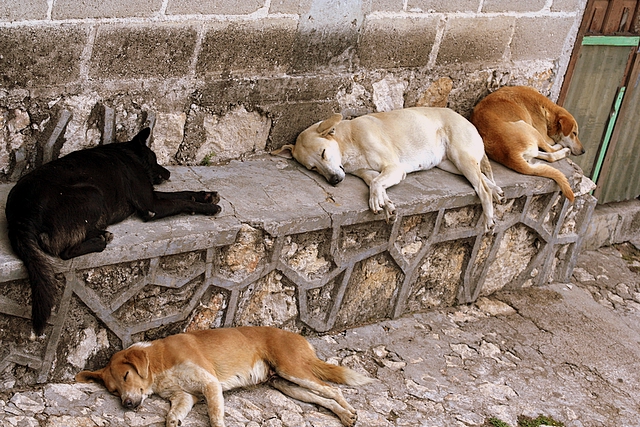
Here's something that kind of blew my mind: the majority of the world's dogs are street dogs. Not strays, not abandoned pets - just dogs living freely in human environments the way they have for thousands of years.
Think dogs sleeping under market stalls, wandering through neighborhoods, hanging out near the back of a café. They're not owned by anyone, but they're not really wild either. They've evolved to live alongside people - finding food, forming loose social groups, figuring out which spots are safe and which aren't.
They go by a lot of names: street dogs, village dogs, free-roaming dogs, potcake dogs (a Caribbean thing), community dogs. Different names, same basic idea. For a lot of us in the US it sounds unusual, but globally it's just normal.
There are roughly 700–900 million dogs in the world. Of those, approximately 75% are street dogs. Only about 25% are restricted pets.
Shaped by Survival, Not Breeders
Most dog breeds we're familiar with - Golden Retrievers, Bulldogs, German Shepherds - are actually pretty new. Like, 150–200 years new. Humans decided what traits they wanted, bred for them, and here we are.
Street dogs took a very different path. Nobody was selecting them for anything. Nature was. The dogs that made it were the ones best equipped to survive in chaotic, human-populated environments - smart, adaptable, quick to read danger, and efficient enough to travel long distances without falling apart.
So when people say street dogs seem unusually aware of the world around them, that's not a coincidence. They come from a long line of dogs who had to be.
Purebred dogs are shaped by humans. Street dogs are shaped by survival.
Why They Look the Same Everywhere
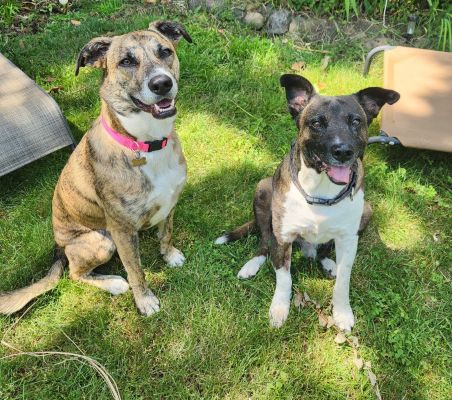
This one is genuinely wild. Street dogs from completely different continents - dogs with zero genetic connection to each other - often look like they could be cousins.
Medium size. Lean and leggy. Pointed muzzle. Upright ears. Short coat. That little curved tail. Scientists call it the "village dog phenotype," and it keeps showing up everywhere dogs have been surviving on their own. It's not breeding - it's just what works. Nature keeps picking that design over and over.
Once you notice it, you see it everywhere. Which made Guante's DNA test results extra interesting.
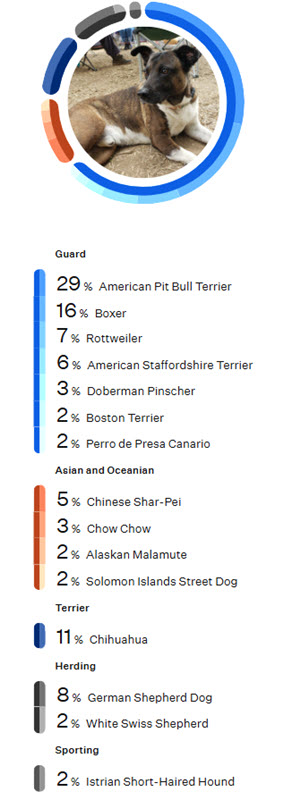
After adopting him, I decided to find out what he was. Mostly because people kept asking if he was an Akita. (He was not.) The results came back listing 15 different breeds - including the Boston Terrier, the Presa Canario, and my personal favorite: 2% Solomon Islands Street Dog. The Solomon Islands are roughly 7,000 miles from Mexico, where Guante spent most of his life.
What DNA Tests Miss
Here's the thing though - it's not really the test's fault. Most dog DNA databases are built around modern, recognized breeds. When the algorithm runs into a dog whose ancestry predates those breeds, it still has to assign something. So it cobbles together the closest matches it can find, even if none of them are really right.
Street dogs aren't usually a mix of 15 breeds. They're more likely descended from a long-running population of village dogs doing their own thing for generations. The DNA test isn't telling you who your dog is - it's telling you the limits of its database. Still fun though. Can't deny that.
Street Smarts Are Real
Life on the street requires a specific kind of intelligence. You're constantly reading your environment. Where's food? Which humans are safe to approach? What routes are actually dangerous? Where can you sleep without getting moved on?
Rescuers who work with street dogs talk about "street sense" a lot - this practical, almost tactical awareness that many of these dogs carry. They tend to be fast learners, solid problem solvers, and really good at reading people.
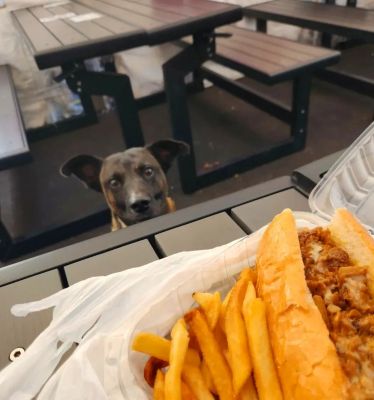
Guante was textbook this. Show him a trick once or twice? Got it, remembered it, done. If food was involved, his memory was almost unsettling. One week he circled back to the exact spot on the sidewalk where he'd found a few french fries days earlier, absolutely convinced it was worth another look.
But the thing I always noticed most was how he handled food around people. He never begged. Never tried to steal anything. He'd just quietly lie down nearby and watch. Patient. Focused. Completely calm. Somewhere along the way he figured out that the calm approach worked better than making noise. It was a small thing, but it said a lot about how he understood the world.
Street dogs seem to carry a quiet kind of wisdom about how the world works.
It's Not All Harsh, But It's Not Easy Either
Street dogs don't always live in misery - a lot of them have informal arrangements with the communities around them. A shop owner who tosses scraps. A restaurant worker who leaves water out. A neighbor who's quietly kept an eye on the same dog for years.
That's why "community dog" is often a more accurate term than "stray." They're not owned, but they're not alone either.
That said - the hard reality is real. Traffic, illness, parasites, untreated injuries, terribly mean people. Guante had likely been hit by a car at some point before he was rescued. His front leg had healed wrong, which means he'd had to keep surviving while recovering with no help at all.
And yet, so many of these dogs still approach people with curiosity and hope. They still form deep bonds when someone shows them kindness. Even after everything. When they finally find a home, that hope shows up as extraordinary loyalty.
Guante
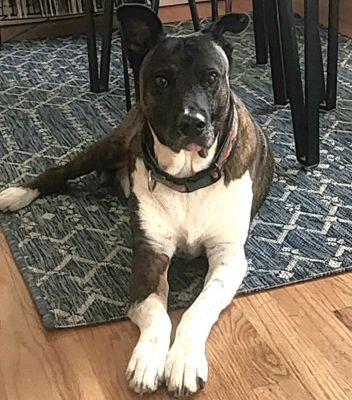
Guante lived his adult life as a street dog in La Paz, Mexico. He came to the US at nine years old. For years he did what millions of street dogs do: paid attention, adapted, figured things out.
By the time he made it to Oregon through Street Dog Hero, he already had all of it - the awareness, the resilience, the food-finding recall that bordered on eerie.
But once he had a home, he didn't have to use any of that to survive anymore. He could just... be a dog. Bond with people. Enjoy his life and enrich mine. Give back the kind of love that dogs are pretty much unmatched at giving.
That's the whole thing about street dogs. They bring all that history with them - and then they just love you with it.
The Guante Bridge was created in his honor.
Each time enough donations come together, the next rescue dog's adoption fee is sponsored through Street Dog Hero - helping another street dog cross from survival to home. One pawprint at a time.